
Many years after his exile, travellers journeying from Britain to Denmark spoke of the boy, Hvalp, fatal destiny, which they knew only through rumours. It happened one day, near Solbækgård.
Coming soon: The innocence of Hjalmar in English…
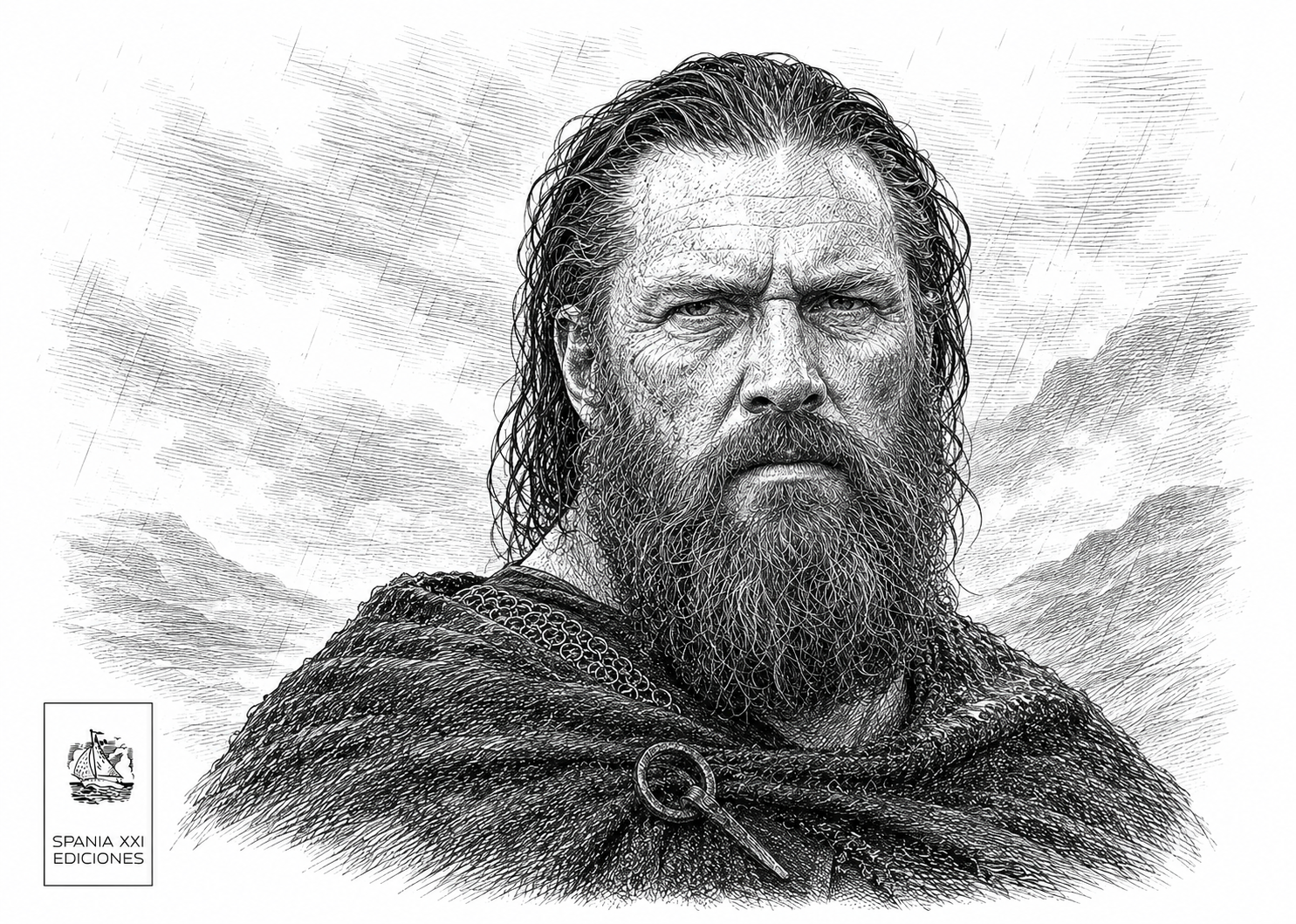
On a day when the air was unbearable with cold, blowing from the north and forcing Ravnhild to clutch his cloak beneath his chin with one hand, he discovered that, through a mistake, he had strayed somewhat to the south: he caught sight of the Flensburg Fjord and realized his error, and so corrected his course northward. Near Solbækgård, he saw two figures walking along the path, at roughly a day’s journey from Aabenraa. As on so many days in those lands, it was a taciturn dusk with little light, beneath an overcast sky that threatened rain at any moment. On one side of the walkers lay cultivated fields; on the other, dense woods and brambles. Everything was painted in an intense emerald green, one of those colors that could be breathed in, that filled the spirit with life. One of the travelers was a child; the other appeared to be an adult. He came up to them and greeted them as courtesy demands of a traveler, and he recognized the child.
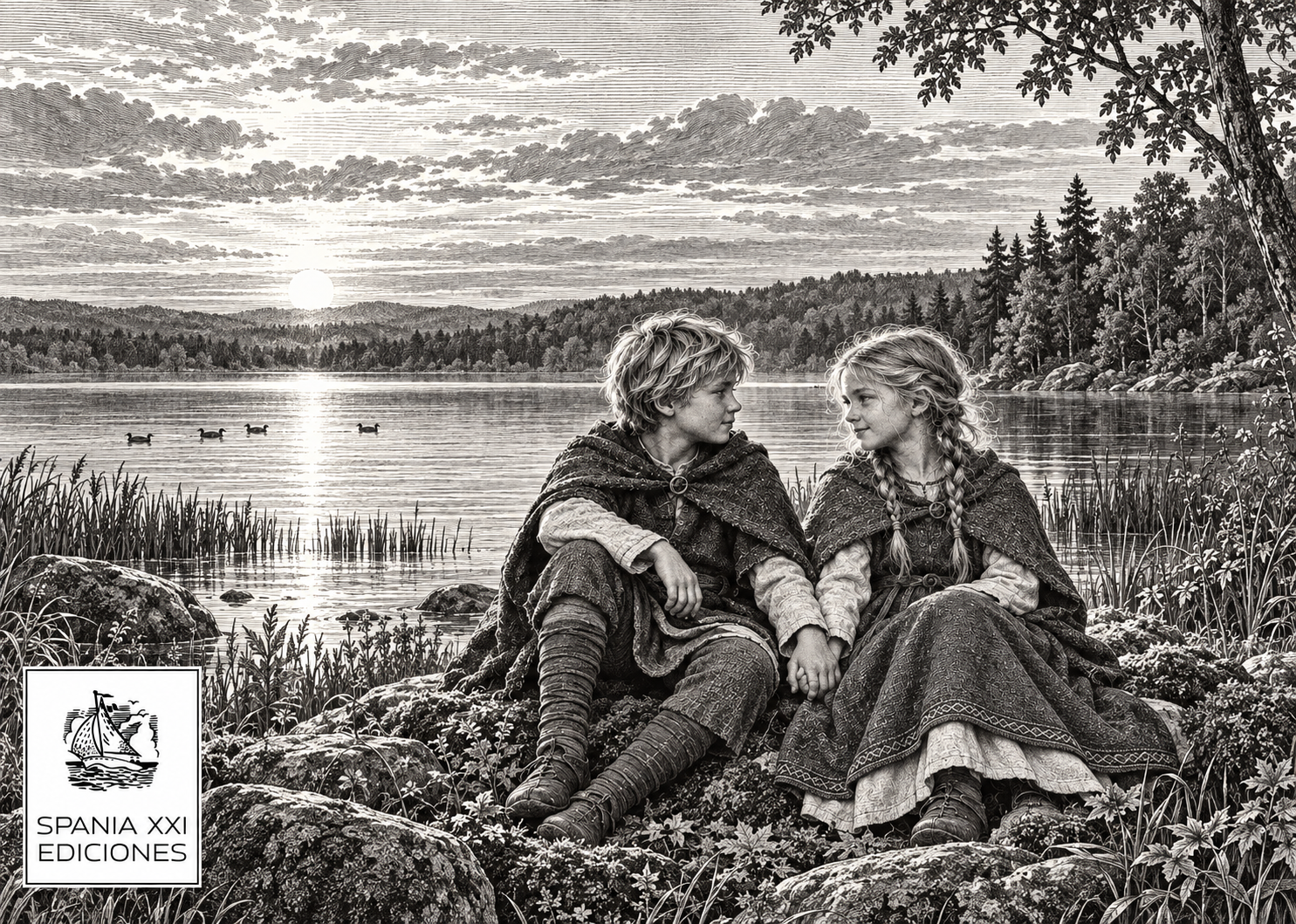
It was Thorstein “the Boy,” the son of Gyrd Thorsteinssen, the brother of the young man who had mistakenly carried off his father’s cloak. He was now already a prepubescent youth of perhaps twelve or thirteen years. Ravnhild did not know who the other figure was. For a brief moment he felt the urge to demand the return of the lost garment, but that hope was vague and soon faded; still, he addressed them, slowing his horse and turning so as to speak to them face to face.
The boy was holding the adult by the arm, a man exceedingly unkempt, with dishevelled, filthy hair and cheeks worn and cracked, almost like a living corpse. His eyes were covered with a black, grimy cloth tied behind his head, and he walked stiffly, cautiously, testing each step, for he was clearly blind. Then Ravnhild understood that Thorstein “the Boy” was leading him as a guide, serving as his eyes, no doubt escorting him back home, for the afternoon was already far advanced. When Thorstein “the Boy” saw Ravnhild’s face, he too recognised him:
“Greetings, young Thorstein. I hope you will convey my best wishes to your father,” he said.
The blind man, who even before the words encourages had perceived the horse by its snort and smell, stood very still and upright. The boy looked at Ravnhild with enthusiasm, for he recognised him and felt great admiration toward him, as all Danes did toward those who sailed the waves and steered those marvellous ships to distant lands.
“I will tell him, sir. May you have a good journey,” he replied.
Then Ravnhild felt compelled to give them the news, for sooner or later they would learn of it, and concealing the truth was merely the work of cowards afraid to face destiny head-on:
“I must also give you grievous news. Know that Sigurd’s host was slaughtered by the army of Edward the Younger in Mercia, one of the kingdoms of Bretland. The dead covered the field by the hundreds. The ravens made that day their greatest feast, and the prisoners were subjected to a butchery at the hands of their captors… That is what is said in York. The young man Hvalp was among that host. They marched south at the end of spring. It was my duty that you should know this. Let your father know as well…”
“I will tell him…” Thorstein replied, somewhat shaken by the bluntness of the news. He did not know Hvalp very well, yet he could hardly rejoice at the death of his uncle in distant lands. He grew pensive for a moment; but the matter of Hvalp had long since faded from memory at Solbækgård, for ten years had passed since his departure and, in truth, everyone had assumed the young man had already died.
Ravnhild rode away down the road on his horse. The wind struck him from the side, and his cloak billowed like the tattered banner of a retreating army. Thorstein the Child tugged at the arm of his companion so that the two might continue toward Solbækgård. After a moment, he asked the blind man with ingenuous curiosity:
“Flyve, do you think Hvalp is dead?”
Since his eyes had been seared, Flyve had, as was to be expected, undergone a complete transformation in his way of life. Everything suggested that his condition would turn him into a burden, that he might end up sacrificed or abandoned; yet none of that came to pass. His blindness seemed instead to awaken in him divinatory powers, which manifested as intuitions and sensations. Everyone in the region was astonished by his ability to warn of dangers, anticipate events, and glimpse remedies. Many even came from afar to listen to his words. That society—entirely permeated by irrational beliefs and portents—found in such figures people worthy of great esteem; thus, they were carefully tended and even revered. Now he was held in greater respect than before, despite his pitiable condition.
His dry, cracked lips spoke for the first time as he took short, carefully measured steps, leaning on the arm of young Thorstein:
“Life is full of infinite chances, Thorstein. What the traveler said is that the army was defeated and that all its members were killed. However, we do not know whether Hvalp was among them.”
“But Ravnhild said he was following Sigurd’s host.”
“All I can tell you is that the place in my heart where Hvalp once had his seat remains full.”
“Then we will not tell father anything, because, in some way, Hvalp has survived…” Thorstein stated with conviction. There was an eloquent silence. Everything had been said. And they turned left onto the path that led to Gyrd’s farmstead, which Thorstein’s son had adopted as his new home, and which had once belonged to his father.
(The innocence of Hjalmar, chapter V)




Leave a Reply